
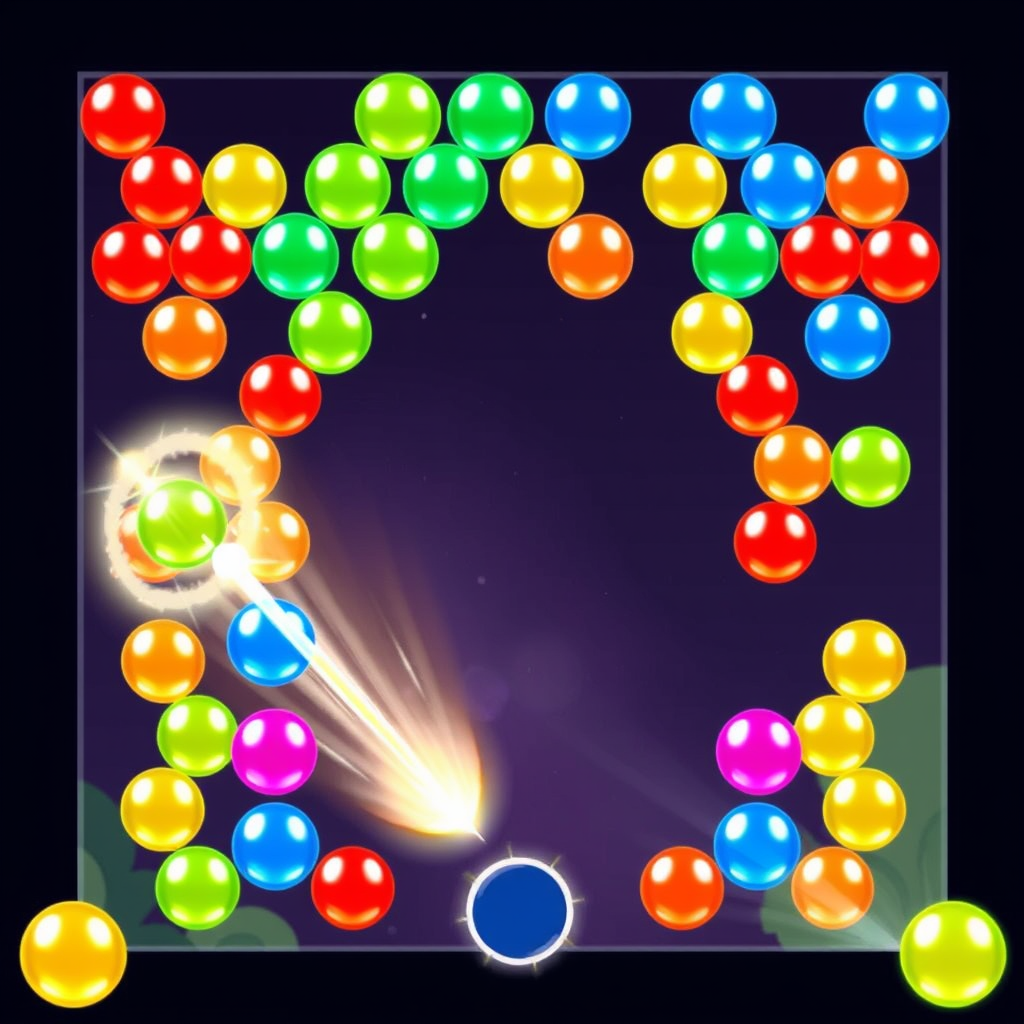
Bubble Shooter Games: Aim, Combos & Winning Strategy
By Jabali Game Design Team · Published on Aug 11, 2026
Bubble shooter games are aim-and-match puzzlers: fire a colored bubble at a hanging cluster, connect three or more of the same color, and clear the board before it reaches the bottom. They look casual, but consistent high scores come from a small set of learnable skills — bank shots, color management, and planning two turns ahead instead of one.
This guide covers the techniques that separate lucky clears from repeatable ones, how to rescue a "stuck" board, and how to build your own bubble shooter without code.
How Bubble Shooters Actually Work
Every bubble shooter shares the same core rules: a shooter at the bottom, a descending ceiling of bubbles, a match-3 clear condition, and a queue showing your current and next bubble. Most versions add wall-bounce physics, which is where the skill ceiling comes from.
Two things decide most games: the color distribution the game feeds you, and whether you waste bubbles. You cannot control the first. The second is entirely on you.
Aim: Direct Shots vs. Bank Shots
- Use direct shots for short, clear paths. Less can go wrong.
- Use bank shots (bouncing off the side wall) to reach clusters hidden behind the front row or to thread into pockets. Bank shots are the single biggest skill jump in the genre.
- Practice with aim lines on, then play rounds without them. Training with the guide, then removing it, builds real trajectory intuition fast.
- Aim at the attachment point, not the bubble. A shot that lands where a cluster connects to the ceiling can drop everything below it. Detaching a big branch scores more than matching three bubbles ever will.
Color Management and Two-Turn Planning
- Always check the next-bubble preview before shooting. The best move often uses the current bubble to set up the next one.
- Never add a third color to a region you are trying to clear. Park useless bubbles on the far side of the board where they block nothing.
- When the board offers no good shot, deliberately shoot a low-value bubble into a harmless pocket. Spending one bubble to avoid ruining a setup is a pro habit, not a waste.
Power-Ups and Stuck Boards
- Hold power-ups as long as possible. Late-board clears multiply your base because more bubbles are in play.
- On "stuck" levels, stop matching and start disconnecting: focus only on the color clusters that anchor large sections, plan two turns, and do not burn a power-up early.
- If the ceiling is about to drop, clear the widest section first — width, not height, is what ends runs.
The Most Popular Bubble Shooter Games
- Puzzle Bobble (Bust-a-Move, 1994) — the Taito original that invented the formula; still the design reference.
- Bubble Shooter (the web classic) — the browser version millions know from portals like Arkadium; the genre's evergreen entry point.
- Bubble Witch 3 Saga — King's take: narrative wrapper, boss levels, and polished live-ops.
- Panda Pop — rescue-themed variant that proved a goal beyond "clear the board" boosts retention.
- Talking Tom Bubble Shooter — character-driven version showing how IP skins refresh the same mechanic.
How Big Is the Bubble Shooter Market?
Bubble shooters live in the puzzle category, and puzzle is a monster: $14.4 billion in mobile consumer spend in 2025, the strongest-growth mobile genre (Sensor Tower). Puzzle and strategy together captured over a fifth of global mobile revenue from only about 4% of downloads — meaning puzzle players spend more deeply per player than almost any other audience. The broader games market context: $201.6 billion in 2025 (Newzoo).
How to Design a Good Bubble Shooter
- Fair color feeds. Players forgive hard boards, not impossible ones. Guarantee the queue can always make progress.
- The attachment-point rule. Reward detaching branches more than matching trios — it's the mechanic that creates skill expression.
- Visible next bubble. Hiding the queue removes planning, which removes strategy, which removes your audience.
- Pressure that breathes. Alternate tight ceiling drops with recovery moments; constant pressure numbs players.
- Power-ups with trade-offs. A bomb that clears ten bubbles but resets your multiplier is a decision; a bomb that's free points is a checkbox.
How AI Is Changing Bubble Shooters
Modern puzzle games already use AI behind the scenes: level generators that produce thousands of tested-solvable boards, and difficulty models that adjust color feeds to keep players in the flow zone. On the creation side, AI platforms like Jabali collapse production entirely — describe a bubble-shooter twist and play it minutes later, which is why the genre's long tail of variants keeps growing.
Build Your Own Bubble Shooter with Jabali
Bubble shooters are a perfect AI-creation genre: simple physics, clear rules, endless room for twists. Describe your version and Jabali turns it into a playable game you can refine and share.
Prompts to try in Jabali Studio:
- "A bubble shooter where detached clusters drop with physics and can crush other bubbles for bonus points."
- "A bubble shooter with a rotating ceiling and a rainbow bubble that copies the color it touches."
- "A boss-fight bubble shooter where the boss shields random colors every five turns."
Adjust colors, drop speed, and power-up rules visually, playtest with one click, and share your game as a single link. If this is your first game, our 15-minute quickstart walks you through the whole flow, and the Explore page shows what other creators are shipping.
Keep reading: Arcade Games Online · Maze Shooter Games · Shooting Games Online
FAQs
Q: Is it better to bank shots or aim directly in bubble shooters?
A: Use direct shots for short, open paths and bank shots for clusters hidden behind the front row or reachable only through pockets. Bank shots are harder but unlock the highest-value plays.
Q: How do I beat stuck levels in bubble shooter games?
A: Focus only on color clusters that anchor large sections, plan two turns ahead using the next-bubble preview, and save power-ups for late-board clears where they multiply your score.
Q: What is the fastest way to improve at bubble shooters?
A: Practice with aim guide lines turned on to learn bank-shot angles, then play rounds with them off. Aim at attachment points to drop whole branches instead of matching single trios.
Q: When should I use power-ups for maximum score?
A: As late as possible. Power-up clears score more when more bubbles are on the board, so holding them for crowded late-game boards multiplies your base points.
Q: Are free online bubble shooters good practice?
A: Yes. The core physics and strategy are the same across versions, so skills transfer. Reputable free web versions are legitimate training grounds.
Q: Can I make my own bubble shooter without coding?
A: Yes. AI game platforms like Jabali convert a text description into a playable bubble shooter. Describe the twist you want, tune drop speed and colors, and share it as a web link.
Q: How big is the bubble shooter market?
A: Bubble shooters belong to the puzzle category, which generated $14.4 billion in mobile consumer spend in 2025 — the strongest-growth mobile genre (Sensor Tower). Puzzle and strategy together took over a fifth of mobile revenue from only about 4% of downloads.
Q: What are the most popular bubble shooter games?
A: Puzzle Bobble (Bust-a-Move) invented the formula in 1994. Today's leaders include the classic web Bubble Shooter, Bubble Witch 3 Saga, Panda Pop, and Talking Tom Bubble Shooter.
Q: What makes a bubble shooter fair?
A: Guaranteed-progress color feeds. Players forgive difficult boards but not impossible ones, so well-designed games ensure the bubble queue always offers a move that advances the board.