
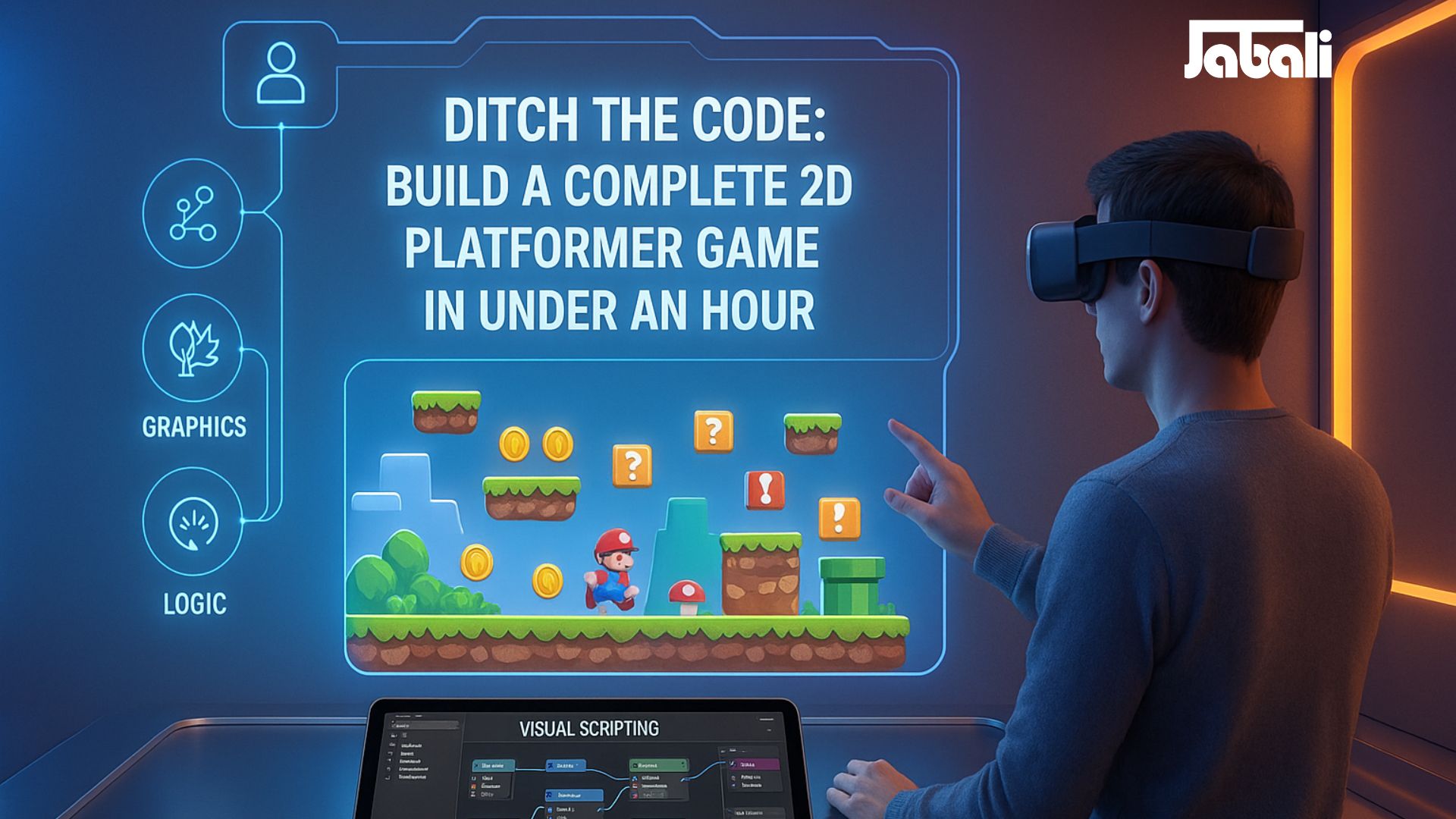
Build a Complete 2D Platformer Game in Under an Hour
By Jabali Team · Published on Sep 19, 2025
Remember when making games meant learning C++ for months? Forget that noise.
Today, you don't need a four-year degree to make something fun. You just need the right tools, a clear plan, and about an hour of focused time.
Yes, we’re going to build a functional 2D platformer—the kind with running, jumping, and basic level hazards—before your coffee gets cold. Sound impossible? It’s not.
This rapid-fire guide shows you exactly how to make a game without coding using Jabali Studio and its AI co-creator, Bali. We’re swapping complex syntax for visual scripts, AI-assisted setup, and rapid prototyping.
The Shift to Visual Scripting
For decades, code was the barrier to entry. If you couldn't write it, you couldn't build it.
That’s changed thanks to modern no-code game development tools. Instead of writing logic in text, you connect visual nodes that represent actions and events.
You’re focusing on design and player experience—not debugging semicolons.
This is exactly what Jabali Studio is built to support. Under the hood, it generates and manages the code for you, but you:
- Describe the behavior in plain language.
- Let Bali create or adjust the visual logic.
- Tweak and test the result right in the editor.
When you say, “Make the player jump when I tap the screen,” Jabali’s job is to translate that into working gameplay without making you touch a single line of code.
Hour One: The Core Mechanics Checklist
If you want a finished game quickly, you have to prioritize. We’re focusing on the basics that make a platformer feel like a platformer:
- Run left and right
- Jump reliably
- Land on platforms
- React to hazards and collectibles
We’re aiming for a Minimum Viable Platformer (MVP) that runs and responds instantly.
Ready to jump in?
1. Get Your Canvas Ready (5 Minutes)
First, set up your project in your no-code editor. In this case: Jabali Studio.
Start a new 2D game and pick a simple template (or ask Bali: “Create a basic 2D platformer starter for me.”)
Let Bali generate a basic scene with:
- A player placeholder
- A ground layer
- A couple of platforms
Assets:
You can either:
- Upload a character sprite and a few tiles (grass, dirt, spikes), or
- Ask Bali to generate quick placeholder art: “Give me a simple pixel-art hero and three tiles: ground, platform, and spikes.”
The goal here isn’t perfect art. It’s getting something on screen that you can move around immediately.
2. Defining the Ground Rules (10 Minutes)
Game engines don’t automatically know what “ground” is or how gravity should act. You need to define those rules—but you don’t need to code them.
In Jabali Studio, you can:
Select your ground and platform tiles and ask Bali:
“Mark these tiles as solid platforms the player can stand on.”
Bali sets up the collision layers and physics properties so your character doesn’t fall through the floor.
Then:
Use the level editor (or ask Bali to “lay out a simple starter level with a few platforms and a ground