
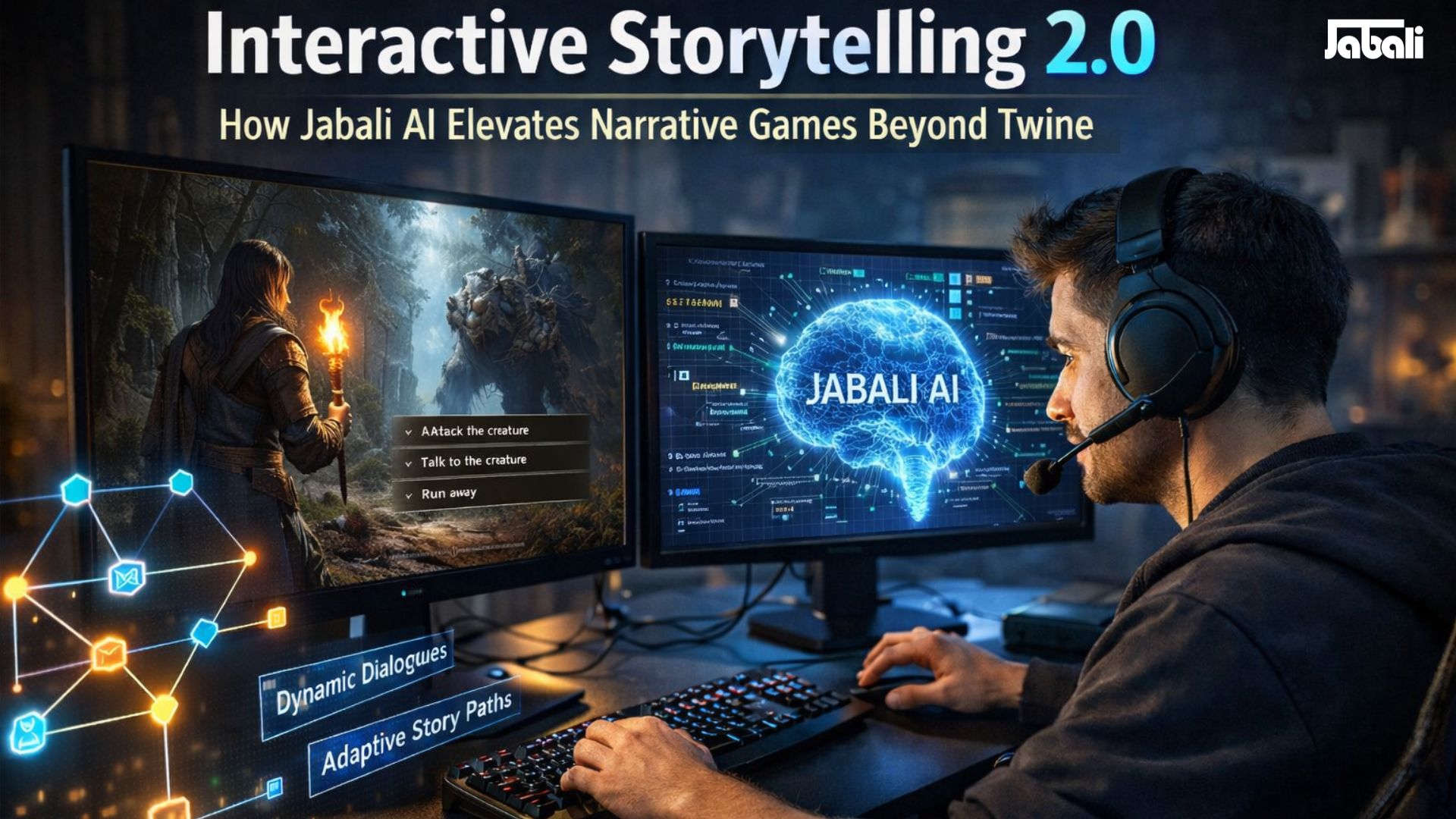
Interactive Storytelling 2.0: How Jabali AI Elevates Narrative Games Beyond Twine
By Jabali Team · Published on Apr 7, 2026
Jabali AI shifts the creation of the storytelling game from a text-focused branching structure to a functional, 2D or 3D game engine. By interpreting narrative commands via Natural Language Processing (NLP), Jabali automates the generation of complex RPG mechanics—including inventory systems, visual assets, and dynamic combat loops—that traditional text-centric tools cannot support without extensive manual code. This allows writers to focus solely on narrative depth while achieving true interactivity.
Key Takeaways
- Jabali converts written narrative scripts directly into executable game logic (Prompt-to-Play capability).
- Enables writers to build complex RPG systems within their storytelling game narratives without manually coding inventory, combat, or state machines.
- The engine is Engine Agnostic, meaning generated code and assets are compatible with existing Godot and Phaser workflows.
- Reduces time-to-prototype for immersive narrative systems that require visual and mechanical complexity from weeks to hours.
Why should writers transition from simple text branching?
Text-only engines, like Twine, excel at purely structural narrative decisions. They are high-fidelity reading experiences. However, modern interactive fiction demands immersion that often requires complex non-narrative mechanics, such as resource management, character stats, and spatial awareness.
Jabali AI is engineered to bridge this gap, automating the mechanical and visual infrastructure:
- Narrative Input: The writer inputs the story sequence via plain text prompts (e.g., "The Hero finds the Sword of Fire in the ruined crypt.").
- Mechanical Interpretation: The multi-agentic AI system identifies the mechanical requirement ("finds," "Sword of Fire," "crypt"). It understands this requires Inventory Generation, Item Stat assignment, and a Visual Asset creation for the environment and item.
- Code Generation: The engine instantly generates the functional code loop (the
function, the stat object definition, and the UI element) while compiling the necessary assets.pickup
How does Jabali automate complex RPG systems for a narrative game?
Building inventory, skill trees, and combat statistics is the most time-consuming step for non-coders attempting a mechanically dense narrative game. Jabali bypasses manual scripting using specific prompt commands.
Inventory and Status Management
Jabali automatically defines item classes and their interaction with player stats based on simple descriptive language. You do not need to define JSON objects or database schema.
Try this Prompt:
"When the player opens the old chest, generate an inventory item called 'Silver Key' that is necessary to open the dungeon door."
Try this Prompt:
"Apply a permanent status effect called 'Curse of Weakness' (-10 STR) after the player reads the ancient scroll."
Instant Combat Generation
If your storytelling game requires a combat sequence—whether turn-based or real-time—Jabali handles the full build-out of the fighting arena, enemy states, and victory/defeat conditions from a single prompt.
Try this Prompt:
"Generate a turn-based battle sequence in a misty swamp. The antagonist is a Shadow Wraith with 150 HP, weak to fire spells and resistant to physical attacks. If the player wins, transition to Scene 5."
This level of mechanical complexity takes minutes in Jabali, compared to weeks of defining classes and scripting interfaces in traditional engines.
What is the actual difference between Jabali and traditional methods?
| Feature | Jabali AI (Prompt-to-Play) | Traditional Narrative Engine (Twine / Basic RPG Maker) |
|---|---|---|
| Asset Integration | Instant via natural language prompts (2D/3D visual output) | Manual creation, import, and linking of spritesheets and assets |
| RPG Mechanics (Inventory / Combat) | Automated through plain-English commands | Manual scripting (Lua/C#), variable setup, and UI construction |
| Code Maintenance | Self-healing technology automatically fixes broken logic and links | Manual debugging and ongoing maintenance of scripted logic |
| Core Focus | Visual, mechanics-driven storytelling games | Branching text logic and narrative pathways |
| Time to Functional Prototype | Hours | Weeks due to scripting and dependency overhead |
FAQ (Frequently Asked Questions)
Can I use existing narrative structures or Twine files within Jabali AI?
Yes. Jabali is designed to accept established narrative flowcharts or exported text files, treating them as the structural backbone, and then instantly wrapping them with functional game mechanics and visual assets.
Does the system require me to define complex numerical character stats?
No. You define stats (e.g., "strength," "wit," "charm") through natural language descriptions. Jabali automatically assigns the necessary data types and variables. When you prompt an event (e.g., "roll a luck check"), the engine executes the necessary comparison logic instantly.
If the generated game logic breaks during testing, do I need to fix the code manually?
No. Jabali includes proprietary "Self-Healing" technology. If a generated script or asset link fails—for example, a combat function references a missing texture—the multi-agent system identifies the error and automatically rebuilds or re-links the necessary components without developer intervention.