
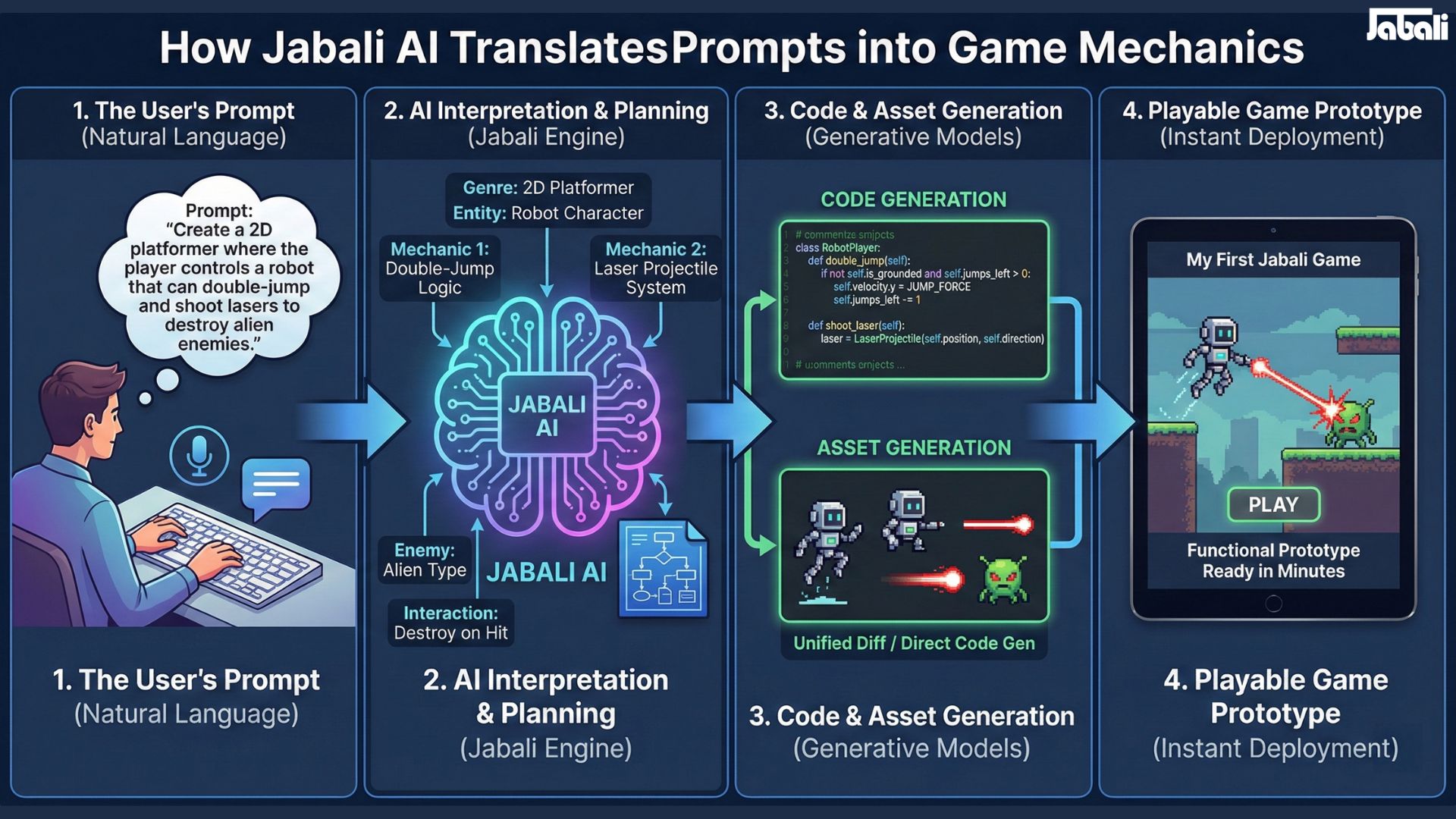
How Jabali AI Translates Prompts into Game Mechanics
By Jabali Team · Published on Feb 6, 2026
Jabali AI uses advanced Natural Language Processing (NLP) combined with a multi-agentic workflow to interpret plain English commands. This system translates abstract concepts, such as "make the character jump higher," directly into functional code logic for specific game mechanics. This process bypasses manual scripting, drastically reducing the time required to build complex interactions.
Key Takeaways
- Zero-Code Creation: Users define complex interactions using plain text prompts instead of C# or GDScript.
- Multi-Agent Coordination: Specialized AI agents handle logic scripting, asset generation, and automated resource linking simultaneously.
- Instant Logic Injection: The engine injects compiled logic directly into the build environment, enabling real-time modification of game mechanics.
- Self-Healing Debugging: Proprietary technology automatically identifies and corrects syntax errors or broken asset pathways generated by the prompt.
How does Jabali AI convert English into code?
Jabali’s Prompt-to-Play system relies on a tightly structured, three-stage AI pipeline. This system ensures linguistic instructions are correctly mapped to engine-specific parameters, such as Godot’s
_physics_processThe overall goal is not simply to write code, but to understand the intention behind the required game mechanics.
Linguistic Parsing and Intent Mapping (The NLP Layer)
The NLP layer receives the user prompt (e.g., "The enemy should patrol between points A and B, reversing direction upon collision"). It breaks the sentence into discrete entities, properties, and relationships. It maps the intention ("Patrol," "Reverse Direction") to known computational behaviors (State Machine).
Agent Assignment and Workflow Orchestration
The system routes the parsed intentions to specialized AI agents. The Logic Agent writes the executable script (e.g., calculating patrol vectors and handling collision events). If the prompt also requires a new asset ("...and play a 'Walk' animation"), the Asset Agent generates or sources the necessary graphic and links it to the Logic Agent’s code.
Script Generation and Hot-Injection
The Logic Agent generates the required script (e.g., C# or GDScript). Crucially, the engine does not require a full compilation cycle. It uses hot-injection technology to insert the new functional code block directly into the running game prototype, allowing for instant testing and iteration of the game mechanics.
Try this Prompt:
"Hey Bali, every time the player destroys an asteroid, increase the player's score by 50 points and increase the asteroid spawn rate by 10%."
What is the benefit of the Multi-Agentic Workflow?
Traditional game development requires manually syncing work across disciplines. A designer dictates a rule, a programmer codes it, and an artist generates assets, often leading to synchronization failures.
Jabali’s multi-agent system eliminates this lag. All agents work concurrently, solving common integration failures immediately. For example:
| Issue | Traditional Method Fix | Jabali AI Fix |
|---|---|---|
| Missing Asset Reference | Programmer writes code while the asset folder is empty, causing a null reference error at compile time. Manual investigation and fixing are required. | Asset Agent instantly generates a temporary wireframe asset, allowing the build to run without interruption. |
| Syntax Errors | Misspelled variables or outdated API calls result in failed builds and manual debugging cycles. | Self-healing agent validates generated code against the target engine’s API and auto-corrects syntax before injection. |
This self-contained, automated process reduces "time-to-prototype" from days to mere minutes, solely by removing the manual steps between idea and execution.
Decision Matrix: Prompt-to-Play vs. Traditional Scripting
| Feature | Jabali AI (Prompt-to-Play) | Traditional Method (Unity / Godot Scripting) |
|---|---|---|
| Creation of Game Mechanics | Minutes using plain-English commands | Hours to days of manual scripting (C#, GDScript, Blueprints) |
| Required Expertise | Zero-code; conceptual understanding of logic | Intermediate to advanced programming proficiency |
| Asset Linking | Automated by AI agents during prompt processing | Manual drag-and-drop or explicit file-path coding |
| Error Debugging | Self-healing technology instantly fixes syntax & path errors | Manual identification of compile-time and runtime bugs |
| Iteration Speed | Instant hot-injection | Full build and compilation cycles required |
Frequently Asked Questions
Can Jabali generate complex conditional logic based on player actions?
Yes. Jabali AI excels at complex conditional logic. You can define intricate
IF/THEN/ELSETry this Prompt:
"If the player's energy drops below 25%, THEN flash the HUD red and play the 'Low Power' sound effect. OTHERWISE, display the HUD in the standard blue color."
Can I edit the code generated by the AI for fine-tuning?
Yes. Jabali is engine-agnostic and generates standard, readable code (C#, GDScript, JavaScript). Developers can access and modify the AI-generated scripts to fine-tune specific variables or optimize performance outside of the Prompt-to-Play interface.
Is the speed of generating game mechanics reliable across 2D and 3D projects?
Yes. The underlying NLP and agentic architecture is engine-agnostic and handles 2D (Phaser/Godot) and 3D (Godot) logic consistently. The core complexity lies in logic generation, not asset dimension, ensuring reliable speed regardless of project type.