
How to Make a Game Without Writing a Single Line of Code
By Jabali Team · Published on Mar 22, 2026
Got a brilliant game idea stuck in your head? Maybe it’s a fast-paced platformer, a sprawling adventure, or a clever puzzle game that you know people would love.
But then, the old roadblock pops up.
"I'm not a programmer." "I've never touched C# or Python." "I'm just a creative, not a technical person."
For decades, that was the end of the dream for most of us. We were told game-making was only for people who could stare at lines of code all day.
Well, those days are over.
Yes, You Can Create a Game No Coding Required
I’ll say it again: You do not need to be a programmer to build a video game.
The entire landscape has been flipped upside down. The tools that were once guarded by technical wizards are now open to everyone. Today, the most important skill isn't coding; it's creativity. It's your idea.
How Does This Even Work?
The magic behind this is the world of no code game development platforms.
Think of traditional coding like writing a 500-page instruction manual from scratch. It's slow, and one wrong comma can break the entire machine.
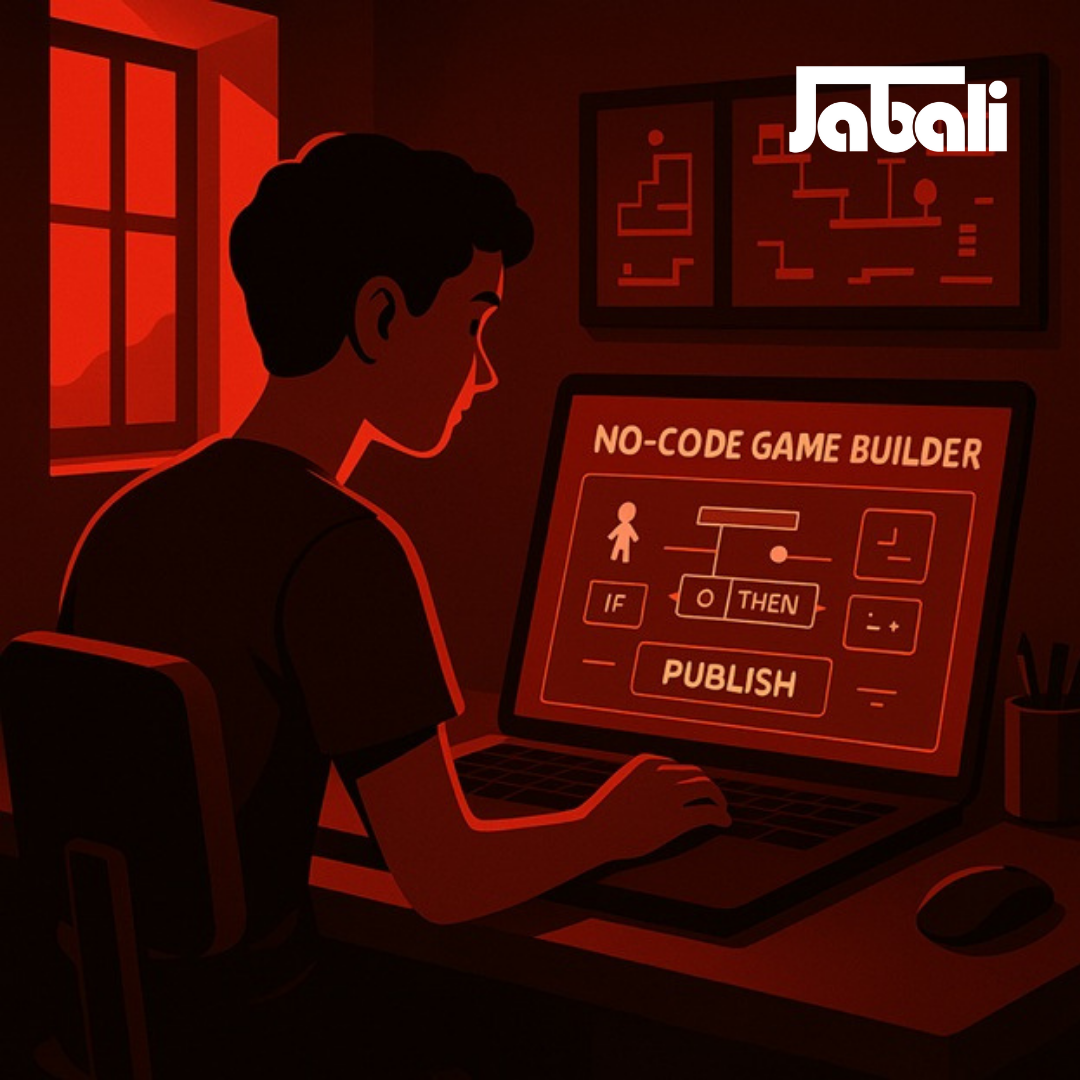
A no-code platform is like using visual LEGO bricks. You're still building the same thing, but you're using pre-made blocks of logic. You connect ideas in plain English:
"When the Player touches a Coin..."
"...Then add 1 to the Score."
You get to be the director, not the typist.
A Modern Plan: From Idea to Game in Minutes
So, where do you start? The old way was still pretty complex. The new way is much, much faster.
Here’s how to make a game without coding using a modern, AI-powered approach.
1. Start with Your Idea (The "What If?")
This is the fun part. Instead of staring at a blank, empty project, you just... describe your game. What if you had a tiny astronaut hopping between floating asteroids? Or a ghost trying to solve its own mystery in a spooky mansion? You start with a simple description.
2. Generate Your World and Assets
This is where everything changes. You don't have to hunt for art or build a level brick by brick. You can use tools, like Jabali.AI, to generate your game world, characters, and items from your description. The AI acts as your creative partner, building the unique assets you need in seconds.
3. Refine and Connect (The "No-Code" Part)
The AI gets you 90% of the way there. Now, you jump into the editor. This is where you use the visual, no-code logic. In a tool like Jabali Studio, you can drag your new character into the world. You can move that platform. And you can create the rules. You tell the game, "When the player touches this key, open that door." It's all drag-and-drop.
4. Play, Test, and Tweak. Instantly.
The second you make a change, you hit "Play" and test it. Is the jump too high? Is the enemy too fast? You just hop back, slide a number, and test again. This rapid-fire process is how you find the fun.
What Can You Actually Build?
Let's be real. Are you going to build a 100-hour, AAA open-world game on your first try? Probably not.
But can you build a professional, polished, and incredibly fun game that you can sell on app stores or share with your friends? Absolutely, yes.
Many hit indie games were built with these exact principles. You can make:
- 2D platformers
- Top-down RPGs
- Puzzle games
- Visual novels
- Mobile-friendly clicker games
- Even simple 3D adventures
The Final Barrier is Gone
The old barrier was logic, and no code game development platforms solved that.
But there was always a second barrier: assets. What about the art? The music? The 3D models? If you weren't a programmer, you also had to be an artist. It wasn't fair.
This is the final wall that's coming down. Platform like Jabali.AI don't just help with logic; they generate the unique art and worlds for you. You get to focus on the one thing that matters: your idea.
Stop letting "I'm not a programmer" be the excuse. The rules have changed. Go create a game no coding needed, and finally show the world what you've been dreaming up.