
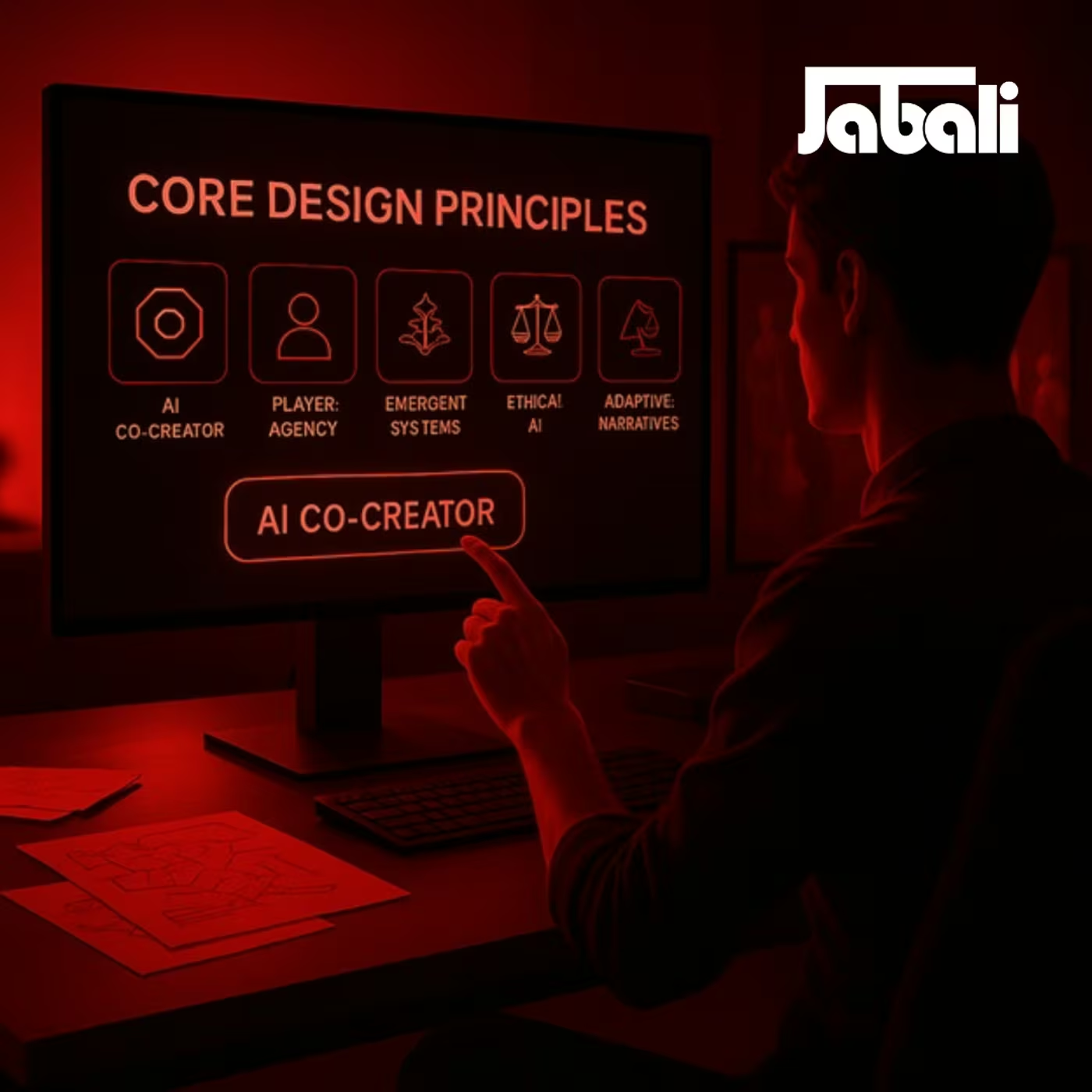
The Blueprint: Core Design Principles for AI-Powered Games
Discover the new blueprint for AI-powered game design. Learn how designers direct AI, hyper-iterate, curate content & build dynamic, player-focused games.
Jabali Team
Sep 12, 2025
4 min read
Game development used to be a marathon. Bringing an idea to life involved months—sometimes years—of painstaking work across multiple disciplines: coding, art, animation, and sound design.
The core game design principles often got bogged down by the sheer effort of production.
Now, that landscape is shifting dramatically.
AI in game design isn't just a futuristic concept; it's a present-day reality that's changing how games are made.
When AI can handle much of the heavy lifting—generating assets, writing code, even designing levels—what does the role of the game designer become?
This new era requires a new blueprint, a fresh set of game design principles tailored for AI powered games.
1. Design Becomes Direction
The most fundamental shift is the designer's role.
It moves from being solely a creator to also being a director.
Instead of manually crafting every asset or line of code, the designer guides the AI.
This involves:
- Setting a Clear Vision: Defining the game's core loop, aesthetic, and emotional goals with precision.
- Mastering the Prompt: Learning how to communicate intent effectively to AI tools. Vague instructions yield generic results. Specific, detailed prompts are the new essential skill.
- Defining Constraints: Telling the AI not just what to create, but also what not to create. Setting boundaries ensures the output aligns with the game's vision.
The designer's creativity is now focused on the high-level concept and the specific instructions needed to bring it to life via AI.
2. Hyper-Iteration is the New Normal
One of the biggest game design trends enabled by AI in game design is the incredible acceleration of iteration speed.
What used to take days or weeks—like creating a new character model or prototyping a level layout—can now happen in minutes.
This allows designers to:
- Test Ideas Instantly: Quickly generate playable prototypes to see if a concept is actually fun.
- Fail Faster: Discard bad ideas with minimal time investment.
- Refine Continuously: Make small adjustments, regenerate, and test again in a rapid loop.
This hyper-iteration means designers can explore more creative possibilities and find the core fun of their AI powered games much faster.
3. Curation Becomes Key
With AI generating vast amounts of content quickly, the designer's role evolves into that of a curator.
Quality control doesn't disappear—it just changes focus.
- Selection: AI provides options. The designer chooses the best fit, ensuring consistency with the game's style and quality bar.
- Refinement: AI output is often a starting point. Designers use their expertise to tweak, polish, and add the human touch that elevates generated content.
- Integration: Ensuring that AI-generated elements seamlessly fit within the larger game system, both technically and aesthetically.
Platforms like Jabali.AI facilitate this by allowing easy regeneration and modification of AI-created content within the Jabali Studio editor.
4. Designing Systems, Not Just Scripts
AI excels at managing complexity.
This pushes game design principles toward creating robust systems rather than hand-scripting every single interaction.
This is especially true for AI powered NPCs.
Instead of writing limited dialogue trees, designers define personality traits, goals, memories, and rules of behavior.
The AI then simulates the character's actions and generates dialogue dynamically.
This systemic approach leads to more emergent, unpredictable, and believable game worlds.
5. Player Experience Remains Paramount
Amidst all this technological change, the ultimate goal remains the same: creating a compelling player experience.
AI in game design is a powerful tool—but it's a means to an end.
The core principles of understanding player motivation, crafting engaging challenges, and evoking emotion are more important than ever.
AI should be used to enhance these goals, not replace them.
- Can AI help create more believable AI powered NPCs? Yes.
- Can it generate more varied and interesting quests? Absolutely.
But the designer must always steer these capabilities toward making the game better for the player.
The Future is Collaborative
AI powered games are not about replacing human designers—they're about augmenting them.
This new blueprint embraces AI as a powerful collaborator, freeing designers from repetitive production tasks to focus on vision, creativity, iteration, and curation.
The future of game design is faster, more accessible, and more creative than ever before.